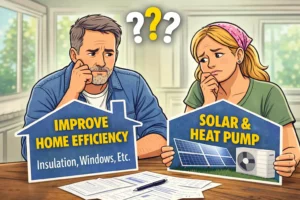
In reality, this is rarely a straight-forward answer.
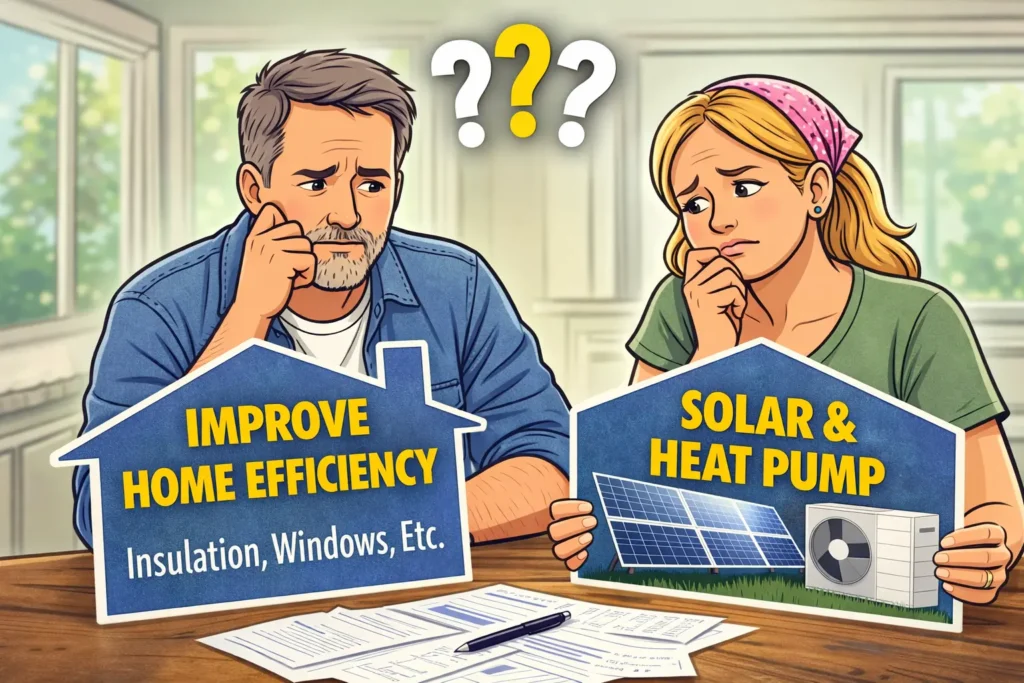
If you’ve spent any time researching home energy upgrades, you’ve probably come across a version of this advice: start with the building envelope. Improve your insulation, seal air leaks, upgrade the windows, then worry about your heating system. Solar comes last.
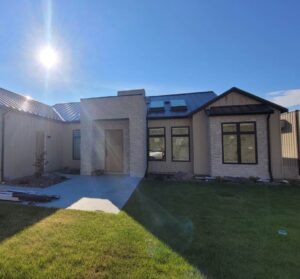
It’s a logical framework, and in plenty of situations with older homes, it holds up. But it doesn’t ALWAYS play out that way. Homes built after 1990 are often air-tight enough to tip the balance in the other direction, where it might make sense to leave the envelope for later and focus on more efficient systems to start.
What “Envelope First” Actually Means
The building envelope is everything that separates the inside of your home from the outside: insulation, air sealing, windows, and doors. The theory behind “envelope first” is straightforward: reduce how much heat your home loses before you invest in the system that produces that heat. From a building science standpoint, that’s correct. Even when considering heating and cooling equipment sizing, this makes most sense.
The challenge is, that theory and reality don’t always agree because there are so many variables that play into the best choice for any particular home.
What We See When We Test Real Homes
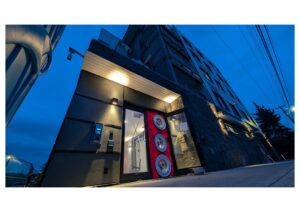
After conducting many blower door tests and energy assessments of homes across BC, a pattern emerges. Older homes, particularly those built before 1990, typically test somewhere between 3 and 10 air changes per hour at 50 pascals (ACH50). Homes from the 1990s through the pre-Step Code era tend to land in the 3 to 5 ACH50 range. Homes built to the current BC Energy Step Code Step 3 requirement need to achieve 2.5 ACH50 or better. Energy Step Code 3 has been a requirement for any new construction that’s taken place since May 2023.
That’s a significant improvement to air leakage in homes over time, and it greatly changes where upgrades make the most economic sense.
Most Homes Aren’t Blank Slates
The homes we assess aren’t usually gutted down to the studs and waiting for a full retrofit. They’re finished homes and are expensive to modify. They might be heated with electric baseboard heating and have no existing ductwork. These homes might have a high number of custom windows and can have expensive finishes as well.
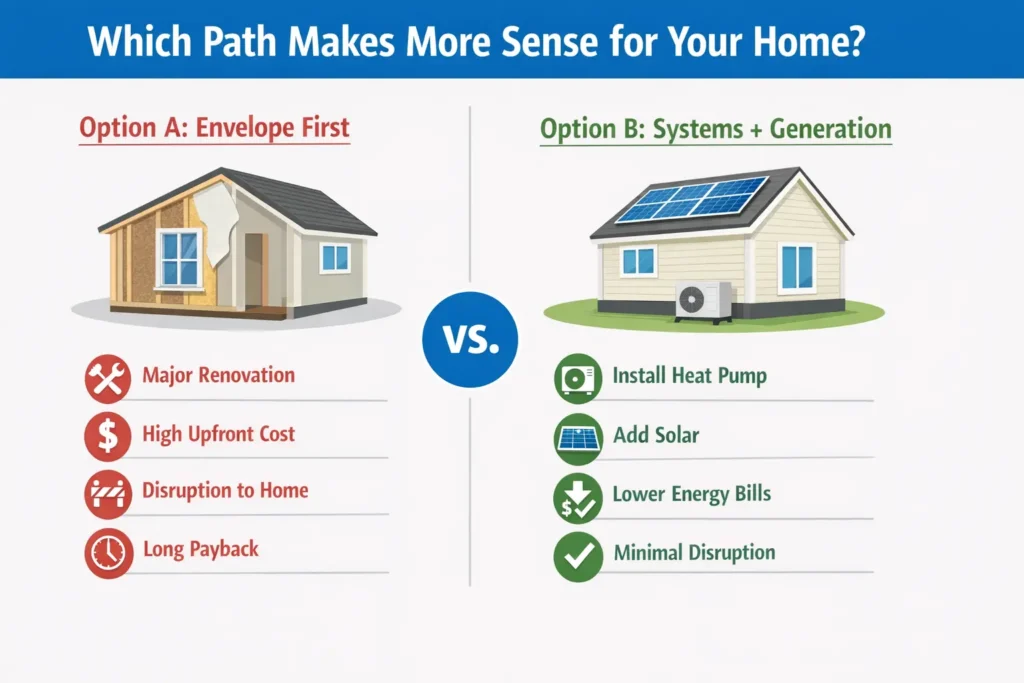
In that context, “envelope first” can mean cutting into finished walls, removing siding, replacing expensive windows, and rebuilding entire assemblies. Costs can climb quickly into the tens of thousands, or higher. For most homeowners, that’s not a realistic starting point.
The Economics Have Shifted
At the same time, the cost of other energy solutions has dropped considerably. Solar is approaching $2 per watt installed in many parts of BC, which means a $40,000 system can produce 20,000 to 25,000+ kWh per year. Combined with net metering, summer overproduction helps offset winter heating loads. Meanwhile, heat pumps have become significantly more efficient and accessible.
When you run those numbers against the cost of a deep envelope retrofit on a finished home, the comparison gets interesting.

How Homeowners Think About It
In our experience, homeowners want to know what gives them the best return with the least disruption to their home and family. When you lay the options side by side, major construction with a long payback versus a heat pump and solar with immediate bill savings, most people lean toward the latter.
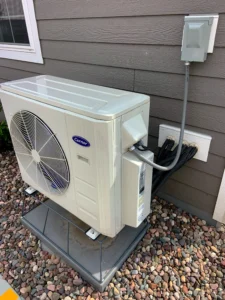
That’s not a bad decision. In many cases, switching from baseboards to a heat pump and adding solar will reduce energy use more dramatically, and more quickly, than envelope upgrades on a home that’s already reasonably tight.
The Diminishing Returns Reality
Once a home is already testing in the 3 to 5 ACH50 range, further air sealing still helps, but the cost per unit of energy saved starts to climb. This is where the diminishing returns on envelope work become apparent. It doesn’t mean those upgrades aren’t worth doing; it means timing matters.
A Word on Windows
Window replacement is one of the most common inquiries we get. The honest answer is that windows do improve comfort, reduce drafts, and look great, but in homes that are already reasonably well-insulated, the energy savings alone rarely justify the cost of full replacement. Most homeowners who replace windows do so as part of a renovation, not purely for energy savings, and that tends to be the right call. People also make this choice in their prioritization of comfort (reduced draftiness) and sound-dampening from road, or other outside noise sources. There are many factors to weigh into this decision.
An Important Consideration: Ventilation and Radon
Here’s something that often gets left out of the envelope conversation: the tighter you make a home, the more critical mechanical ventilation becomes. In a leaky older house, fresh air comes in whether you want it to or not. In a sealed home, you need a deliberate ventilation strategy – typically an HRV or ERV – to maintain indoor air quality.
This is especially relevant in the Okanagan. The Kelowna area and much of the BC Interior sit in a region with elevated radon potential. Radon is a naturally occurring radioactive gas that enters homes through the ground, and it’s the second leading cause of lung cancer in Canada. In a leaky home, radon can dilute more easily. Seal that same home without addressing ventilation, and radon levels can rise significantly. This is dangerous and needs to be assessed before any air sealing measures are undertaken. See our blog post on radon here.
If you’re planning any air sealing work, radon testing should be part of the conversation. It’s inexpensive, straightforward, and something we factor into our assessments. Tighter is better for energy, but only safe when paired with proper ventilation.
A More Practical Path for Home Energy Upgrades in BC
For most existing homes in BC, a sensible sequence often looks like this: start with targeted air sealing where it’s cost-effective, upgrade the heating system to a heat pump, add solar where it makes sense, ensure ventilation is handled properly, and plan envelope improvements around future renovations. This approach still reduces energy use, lowers emissions, and improves comfort. It also aligns with how most people actually invest in their homes over time.
That said, envelope-first absolutely makes sense in certain situations: very leaky homes testing well above 6 ACH50, poorly insulated houses, major renovation projects, and new construction. In those cases, the gains are significant enough to prioritize.
When “Envelope Last” Doesn’t Mean “Envelope Never”
It’s worth being clear: we’re not suggesting the envelope doesn’t matter. It absolutely does. The goal is to make smart decisions in the right order, based on your actual home.
We don’t install heating systems or solar panels. Our job is to help you understand your options using real testing data, local energy rates, and your specific situation, so you can avoid costly mistakes and make decisions that fit both your home and your budget.
The goal hasn’t changed: lower energy use, lower emissions, better homes. But the path to get there is evolving, and in many existing homes today, it might not start with the envelope. It might end there.
If you think your home would benefit from air tightness testing to see what makes sense for you, reach out.