
If you live in the Okanagan Valley and are thinking about replacing your home’s heating or cooling system, you’ve probably considered:
Should I switch to a heat pump, stick with natural gas, or go with a hybrid system?
It’s a question we hear constantly, and for good reason. The choice affects not just your comfort, but also your energy bills, environmental impact, and long-term financial return.
Thrive Energy does not install HVAC systems and we have no financial incentive to recommend anything here.
Our mission is to share information with homeowners so you can make confident and informed decisions.
This guide will walk you through real numbers based on local data, and the pros and cons of each system type.
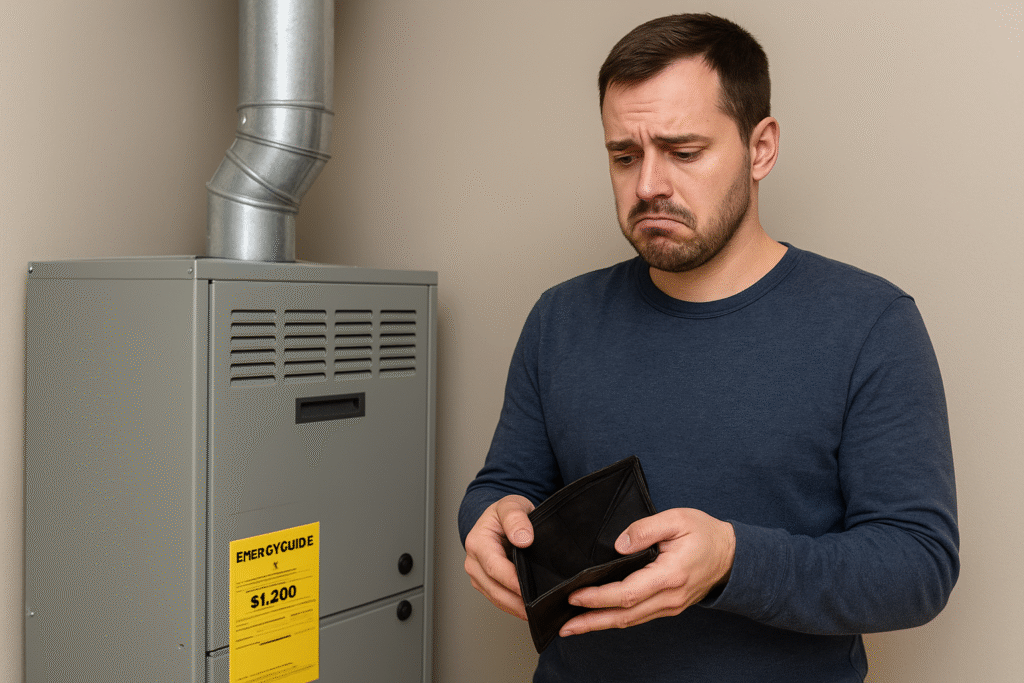
Why This Question Matters More Than Ever
Natural gas used to be the easy, affordable default. In recent years, rising gas prices, carbon fees, and generous rebates for electric heat pumps have changed the balance.
For many Okanagan homes, a heat pump can now match or even beat gas for heating costs and it comes with built-in cooling as well.
The right choice depends on your home, your rates, and your goals. Let’s look at the math.
Energy Cost Comparison for the Okanagan
Depending where your home in the Okanagan is located, your electricity utility provider will vary and thus your cost of energy will vary.
Let’s look at that variable when it comes to the coefficient of performance (COP) required by a heat pump in order for its operational cost to be comparable to that of a 96% efficient gas furnace:
- A BC Hydro customer needs a seasonal average COP of 3.0 to match the cost of a 96% efficient gas furnace. (A heat pump with a COP of 3.0 delivers 3 units of heat for every 1 unit of electricity consumed)
- A FortisBC electricity customer needs a COP of 3.5 to break even with a 96% efficient gas furnace.
Most modern cold-climate heat pumps in 2025 can reach or exceed these performance levels in Okanagan conditions. COP is a parameter you’ll absolutely need to pay attention to in your equipment selection in consultation with your HVAC company in order to reduce the heat pump’s operational costs.
Of note: for a heat pump to operate at its designated COP, it needs to be designed properly with your home and your ductwork. A heat pump which doesn’t match well with the existing ductwork, and isn’t sized correctly for the home’s heating and cooling needs, will not operate at its listed COP and therefore will not match its expected cost of operation. Duct flow testing, duct flow testing, duct flow testing. Heat load calculations, heat load calculations, heat load calculations. I’ll leave it at that.
The Hidden Advantage: Heating and Cooling in One

A heat pump isn’t just a heater. It’s also an ultra high-efficiency air conditioner.
If you already have central AC or are considering adding it, a heat pump can replace both your furnace and AC in a single system.
That means:
- One system to maintain
- Lower total energy use
Even if the heating cost is close to gas, the cooling benefit and year-round comfort often make heat pumps the smarter long-term choice.
The Upfront Cost Difference Based on 2025 Market Prices
Here’s what real-world installed system prices currently look like across the Okanagan:
| System Type | Typical Installed Cost (Before Rebates) | Eligible Rebates | Typical Lifespan | Key Notes |
|---|---|---|---|---|
| High-efficiency gas furnace (only) | $5,000 – $7,500 | Minimal (if any) | 20–25 years | Heating only; separate AC required. |
| Central air conditioner (only) | $4,500 – $6,500 | None | 15–20 years | Cooling only; often paired with furnace. |
| Cold-climate heat pump (heating + cooling) | $11,000 – $16,000 | $3,000–$7,000 | 15–20 years | Fully replaces both systems; electric only. |
| Dual-fuel hybrid (new gas furnace + heat pump) | $15,000 – $20,000+ | Up to $5,000 | 20+ years | Combines both systems; uses gas only in extreme cold (depending on user-set switchover temperature) |
Note: Actual quotes in 2025 across BC commonly show dual-fuel systems around $17,000–$19,000 before rebates.
After applying a $5,000 rebate, the net cost typically falls near $12,000–$15,000.
Realistic Payback and Break-Even Estimates

How long until a heat pump or hybrid system “pays for itself” depends on your rates, efficiency, and usage patterns.
Here are realistic examples based on Okanagan energy prices and efficiency data:
| Scenario | Upfront Cost Difference as Compared with Furnace and A/C (after rebates) | Typical Annual Energy Savings | Estimated Payback |
|---|---|---|---|
| Full heat pump (BC Hydro) | $3,000–$5,000 | $300–$500/year | 6–10 years |
| Full heat pump (FortisBC) | $4,000–$6,000 | $200–$400/year | 8–12 years |
| Dual-fuel hybrid (gas + heat pump) | $1,000–$3,000 (after $5K rebate) | $250–$450/year | 4–7 years |
After hitting the break-even point, savings continue every year after you’ve already paid off the premium for the higher-efficiency system.
If you’re replacing both a furnace and an air conditioner, the heat pump or dual-fuel option often becomes the better value right away, even before energy savings are factored in.
Efficiency Ratings Explained (COP, HSPF, HSPF2)
Here’s what to look for when comparing system performance:
- COP (Coefficient of Performance): Measures efficiency. COP 3 = 300% efficient for every kW of electricity used.
- HSPF (Heating Seasonal Performance Factor): A higher HSPF means better seasonal efficiency – the system provides more heat for each unit of electricity used.
- HSPF2: The updated 2023 testing standard for HSPF (typically 10–12% lower numerically).
Target efficiencies for operational cost break-even point as compared with 96% efficient gas furnace:
- BC Hydro Electricity Utility: HSPF ≥ 10 (HSPF2 9)
- FortisBC Electricity Utility: HSPF ≥ 12 (HSPF2 10–11)
These ratings roughly equal COP 3.0–3.5 over a typical heating season.
The Balance Point: Why It Matters
The balance point is the outdoor temperature where your heat pump can no longer keep up with heating demands and backup heat kicks in.
- In the Okanagan, that point is usually between –5 °C and –10 °C.
- Dual-fuel systems automatically switch to gas heat below that point, ensuring efficiency and reliability.
- The lower your balance point is able to be, the more you’ll save each year.
Environmental and Long-Term Perspective
Even with higher upfront costs, heat pumps and hybrid systems deliver strong long-term value because they:
- Use 98% renewable BC electricity
- Cut household carbon emissions by up to 60–80%
- Are protected from volatile gas prices and carbon surcharges (yes of course, electricity rates change too and that needs to be considered. Installing a solar array can be a consideration for protection from this variable)
- Often increase home resale value by adding efficient, low-emission heating and cooling
In short, they’re highly efficient but also future-ready.
Rebates & Incentives (as of November 2025)
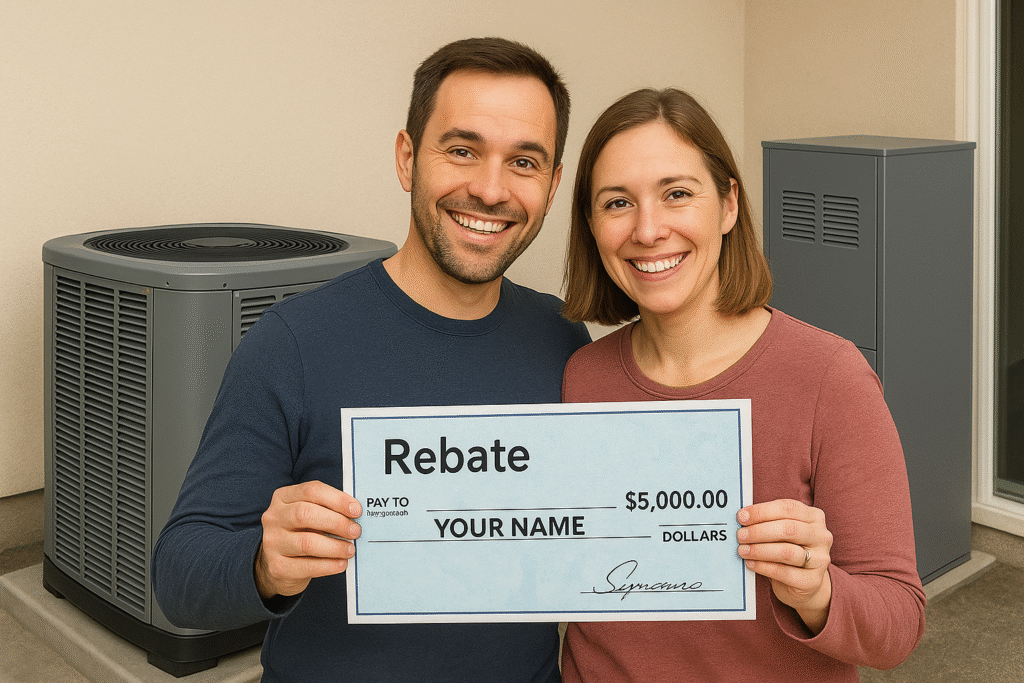
You may qualify for multiple overlapping programs:
- Up to $7,000 for full cold-climate heat pump installations
- Up to $5,000 for dual-fuel hybrid systems
- Additional municipal or regional top-ups in some areas
Always confirm eligibility and approved contractor lists on:
Key Takeaways
| Question | Straight Answer |
|---|---|
| What efficiency matches a 96% gas furnace? | COP 3.0–3.5 (HSPF2 9–11) depending on your utility provider. |
| How long to break even? | 6–10 years for full electric heat pump, 4–7 years for dual-fuel system.(with rebates) |
| Will a heat pump work in cold weather? | Yes — cold-climate units operate down to –20 °C. |
| Do I need backup heat? | Possibly, but hybrid systems handle this seamlessly. |
| What about cooling? | Heat pumps double as efficient air conditioners. |
| What rebates are available? | $3,000–$7,000 for all electric heat pumps, up to $5,000 for dual-fuel systems. |
Thrive Energy’s Role
We’re not HVAC installers, we’re an independent energy education partner.
We want to help homeowners:
- Understand real-world energy costs and system efficiencies, and therefore their options
- Compare gas, electric, and hybrid systems using verified local data
- Navigate rebates and carbon-pricing trends
- Make confident, informed energy decisions without any conflicting sales pressure
Final Thoughts
If you’re replacing an aging furnace or air conditioner, it’s worth looking seriously at heat pumps and dual-fuel systems.
While the initial investment is higher – often in the $15,000–$20,000 range before rebates – the combination of rebates, energy savings, built-in cooling, and long-term stability makes these systems increasingly compelling for Okanagan homeowners as long as the sizing is calculated properly and the ductwork is assessed to ensure it can handle the proposed system.
The more you understand your numbers, the better and clearer your decision.
Have more questions that we haven’t answered here or want to know about your specific situation? Reach out. We don’t have every answer but we are happy to look for answers where we don’t have them.
