We’ve been hearing a lot of community chatter since Carbon Step Code was announced, and there’s one notion that keeps coming up:
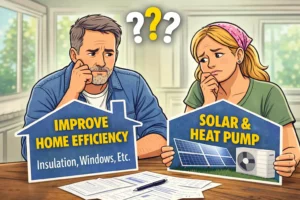
“Is the Province of BC banning carbon? This seems like a gas ban! Are gas furnaces, fireplaces, and water heaters about to be outlawed?”
We get it. The name “Zero Carbon Step Code” sounds like something big, dramatic, and maybe expensive. But here’s the truth: despite the name, the province isn’t banning carbon, and the new code isn’t actually zero carbon – it’s lower carbon.
Let’s walk through what’s really happening, and what it means for your projects.
So, What Is Zero Carbon Step Code?
The Zero Carbon Step Code (ZCSC) is a new set of greenhouse gas performance requirements introduced under the BC Building Code. It works alongside the Energy Step Code, which you’re already becoming familiar with.
Where the Energy Step Code focuses on how efficient a building is, the Zero Carbon Step Code looks at what type of energy it uses and how much carbon it produces.
Instead of just saying, “Make the house airtight and efficient,” the province is now saying, “Also try to reduce the carbon emissions from your heating and hot water systems.”
Why the Name “Zero Carbon” Is Misleading and has lead the general public to claim it’s a “gas ban”
The name makes it sound like builders and homeowners are being required to eliminate all carbon emissions from their projects, but that’s not the case.
The ZCSC is built around performance tiers, similar to the Energy Step Code, and all tiers are low-carbon options – not zero. The zero comes in regarding space and water heating, where, if following the prescriptive path at the highest tier of Carbon Step Code, space, water heating, and cooking appliances must be zero-carbon.
The 3 gas fireplaces in the home? Not an issue.
Outdoor spacing heating using natural gas? Not an issue.
Gas bbq? Not an issue.
Even using the performance path, a builder meeting the any level of the Carbon Step Code could theoretically still use some fossil-fuel heating equipment, as long as the home’s total modeled emissions stay under the required threshold.
Only EL-4 Zero Carbon Performance – the top tier – would fully eliminate carbon from primary space and water heating as well as cooking appliances. Even back-up heating systems may be allowed to use natural gas, as long they’re calculated to fall below the required threshold of emissions by the home.
So, while “zero carbon” makes for a catchy policy headline, in practice, most builders will be aiming for “low-carbon,” not “no-carbon.”
What are the paths and steps of Zero Carbon Step code?
For paths, there are 2: Performance Path & Prescriptive Path
Prescriptive path requires builders to decarbonize energy-intensive appliances like:
- Space heating
- Water heating
- Cooking equipment
Performance path sets overall greenhouse gas emission targets for each Carbon Step.
Builders may choose from different metrics, each one optimized for different scales of homes (small, medium, large). Most builders will need to decarbonize domestic heat, hot water, or both depending on local requirements. However, builders can work with Energy Advisors to determine if other combustion equipment can be included such as gas fireplaces, cooktops and clothes dryers.
The performance path works much like Energy Step Code’s Performance Path, where the Energy Advisor models the proposed building and calculates the outputs to determine compliance, or non-compliance, whatever the case may be and different scenarios can be explored to trial and error which options meet the carbon requirements.
Making changes from a gas furnace to a heat pump, or from a gas water heater to a heat pump water heater, can dramatically cut a home’s modeled emissions — even if it still uses gas fireplaces or a gas BBQ.
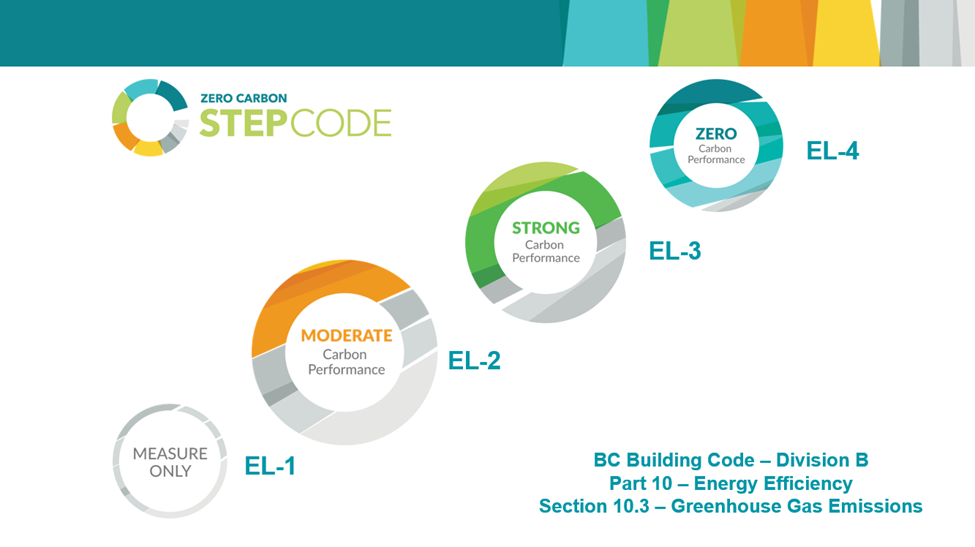
The Steps of Zero Carbon Step Code are:
- Measure-only (EL-1)
- Moderate Carbon Performance (EL-2)
- Strong Carbon Performance (EL-3)
- Zero Carbon Performance (EL-4)
At this time, province-wide, we are at EL-1. EL-1 is measure only and has no requirements on decarbonization for new construction.
Municipalities are currently able to decide for themselves which level of code to adopt, and when. Most places in BC remain at EL-1, while the municipalities below have adopted higher levels of Zero Carbon Step Code:
Municipality of North Cowichan
Why the Province Isn’t mandating a “gas ban”
We’ve seen plenty of social media posts and heard many-a-discussion claiming the province is mandating a “Gas Ban”. While Zero Carbon Step Code undeniably has its challenges for builders and homeowners, it’s nothing of the hysteria created by the term “Gas Ban”.
Municipalities can choose how quickly they adopt the Zero Carbon Step Code, and most are phasing it in gradually.
Builders can still use fossil-fuel systems, provided their overall energy model meets the carbon performance targets.
There are multiple compliance pathways, and nothing in the current code outright bans gas equipment.
In short, you can still build with gas – you just have to balance it with efficient design and lower-carbon systems.
How Builders Can Prepare
If you’re already comfortable meeting Step 3 or Step 4 of the BC Energy Step Code, you’re halfway there.
Here are a few practical steps to start aligning with the Zero Carbon framework:
- Model early. Have your Energy Advisor run a preliminary GHG analysis with your regular Step Code model.
- Consider hybrid systems. Pairing a heat pump with a small gas furnace or water heater can often meet “low-carbon” targets while keeping your options open.
- Stay informed. Different municipalities will adopt ZCSC at different times. Check with your Energy Advisor for updates in your region.
The Flip side of the coin
Key concerns expressed by the public are below and some concerns are absolutely valid:
- Cost and affordability: restrictions on natural gas in new construction are predicted to drive up housing and living costs. Some restaurants are concerned about the higher cost of installing electric lines, although proponents argue upfront costs are offset by long-term energy savings.
- Electrical grid capacity: Phasing out natural gas will significantly increase demand for electricity at a time when BC Hydro is already facing challenges meeting demand, according to the Energy Futures Institute. The North American Electric Reliability Council has identified this as a risk.
- Cultural impact: Some communities, particularly within the restaurant industry, have expressed concern that restrictions on natural gas will negatively impact traditional cooking methods and flavor profiles. The debate around indoor air quality, specifically nitrogen dioxide from gas stoves, is a point of contention.
- Transition challenges: Critics argue the transition to electric alternatives is happening too quickly, especially for rural and remote communities with less reliable infrastructure. Concerns exist about the availability of suitable electric appliances and the cost of retrofitting existing buildings.
- Alternative solutions: Some suggest focusing on alternatives like Renewable Natural Gas (RNG) to integrate into the existing infrastructure. There are also concerns about the high cost and environmental impact of some large industrial projects that are also increasing electricity demand (Energy Futures Institute.)
The Takeaway
The Zero Carbon Step Code isn’t a ban – it’s a gradual and important shift toward lower-carbon homes which comes with logistical and practical complications.
For most builders, it means adjustments to your equipment mix and energy modeling, not a complete overhaul of how you build. I’m not saying it’s not without its challenges, but it isn’t as overwhelming as “Zero Carbon” sounds.
Still have questions? We may or may not have answers, but reach out and we’ll get them for you.