
Written and reviewed by Brett Tracy, Founder and Registered Energy Advisor at Thrive Energy Inc.
Why Sealed Windows and Air Conditioning Are Not Enough
The last couple of Augusts the phone has started ringing about the same thing. Someone wakes up to smoke smell in an upstairs bedroom, or walks in the door after a hot day and the place smells like a campfire. The windows have been shut all week and the AC has been running, and the smoke is getting in regardless.
We’ve had several of these calls in the past few weeks, from West Kelowna, Kelowna and up in Kamloops. Here’s what’s going on, and what a blower door test can tell you about it.
Smoke Follows Air, and Air Follows Pressure
How much your house leaks depends a lot on when it was built. Anything built in BC since the Energy Step Code came into effect in 2023 has to hit 2.5 air changes per hour or better, and it gets tested to prove it, so those houses are reasonably tight. Before that it’s all over the place. A house built in 2019 can leak as badly as one from 1985, because nobody was required to measure it.
Where a house does leak, it behaves like a sieve. It isn’t one big hole, it’s a lot of small ones spread across the ceiling, the walls, the floor and everywhere a pipe or a wire pokes through. On a calm day you’d never know. But the second the pressure inside is different from the pressure outside, air starts moving through them, and it brings whatever is in it along for the ride.
Three things are pushing air through your walls during smoke season:
- The stack effect. Warm air rises and leaks out the top of the house, which sucks replacement air in through the bottom. The whole house works like a slow chimney and it runs all day.
- Wind. It pushes on one side of the house and pulls on the others. Smoke gets shoved in on the windward side and drawn in everywhere else.
- Your own fans. Every bathroom fan, range hood and dryer is throwing air out of your house, and that air has to come back in from somewhere. A big range hood moves several hundred cubic feet a minute. Run it on a smoky day and you’re pulling the outdoors in on purpose.
One homeowner this summer told us the smoke was worst when the furnace was off and somebody had a bathroom fan or the range hood going. That’s a textbook description of a depressurized house, and when we got out there, that’s exactly what it was.
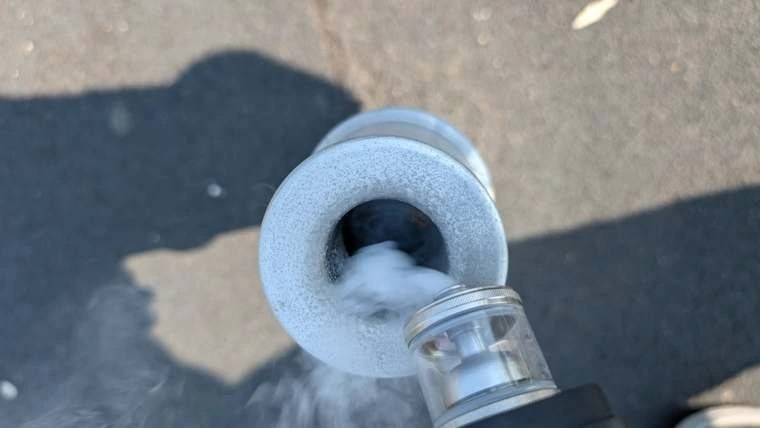
Smoke pencil held at a roof vent with the house pulled negative. The smoke isn’t drifting past the vent, it’s being pulled straight down into it. Whatever is in the air outside is going the same way.
The Leaks You Don’t Know About
Doors and windows are worth a look, and we do find tired weatherstripping. But they’re rarely the main event. The big ones are usually:
- Pot lights in the top floor ceiling. Older can lights are full of vent slots by design. Each one is a direct connection from your living room to the attic, and there can be dozens of them.
- Attic top plates and penetrations. Every plumbing stack, wire, bath fan housing and framing joint up there is a hole unless somebody made a point of sealing it. In most houses built before the mid 2000s, nobody did.
- The attic hatch. Usually a scrap of drywall or plywood sitting on a bare ledge with no gasket on it, so there’s a gap running right around the perimeter.
- Rim joists and cantilevers. Those floor sections that hang out over the foundation, and the framing between floors, get insulated all the time and air sealed almost never.
- Plumbing and wiring penetrations inside the walls. Holes drilled during construction and never closed up. You can’t see them, but the wall cavity they open into connects to a lot of other places.
Count how many of those go to the attic. Attics are vented on purpose, so attic air is outdoor air. When the valley is full of smoke, so is your attic, and every unsealed hole in that ceiling is a straight shot into the bedrooms.
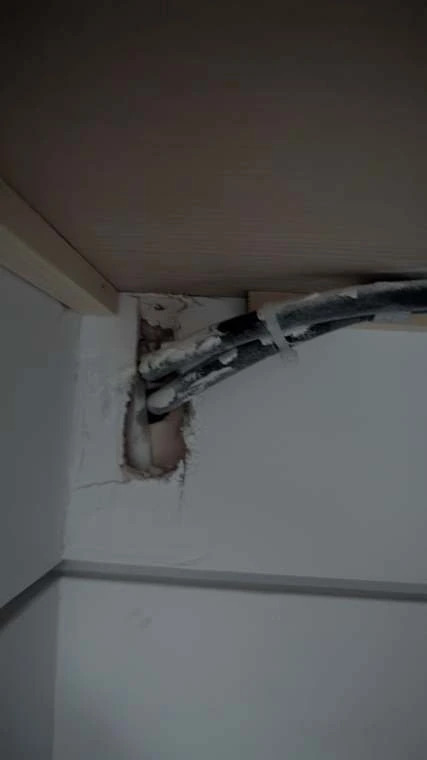
Plumbing penetrations left open into a wall cavity. Nothing is stopping air at this point.
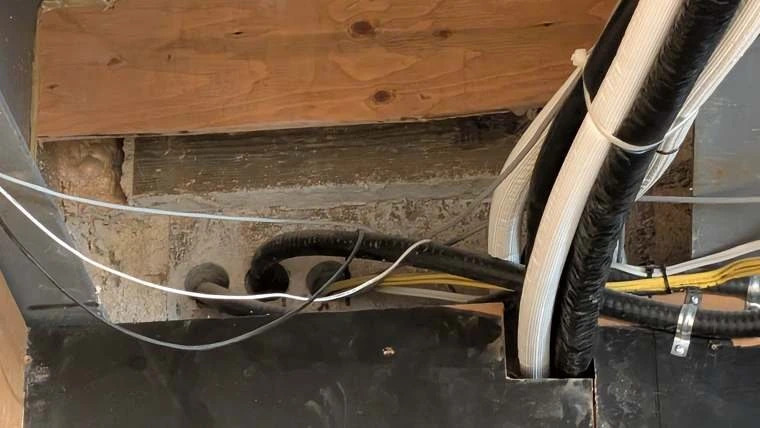
Wiring and pipe penetrations through the wall between an attached garage and the house. Same idea, bigger holes.
Attached garages deserve their own mention. A garage fills with outdoor smoke as fast as any other part of the property, and if the penetrations between the garage and the house were never sealed, that air has a clear run inside. Add a storage or mechanical room in between with an unweatherstripped door on it, and you’ve got a route that bypasses the walls completely.
The Holes That Are Supposed to Be There
Your house probably has some deliberate holes in it. If you’ve got a gas furnace or hot water tank, there’s an open pipe to the outside feeding it combustion make-up air. A lot of forced air systems also have a fresh air intake tied into the return ductwork to bring outdoor air in on a schedule.
Both of those are doing their job. They’re also unfiltered holes to the outside, and on a smoky day they’ll pipe it right in. On one house we tested this summer, the fresh air intake was tied into the return upstream of the bedroom returns, so the outdoor air was getting delivered to the bedrooms first.
Whatever you do, don’t cap the combustion make-up air pipe. We get asked about this every year. That pipe is what stops your gas appliances from backdrafting exhaust into the house when things go negative. Putting a filter on it is fine. Blocking it is a carbon monoxide risk. If you’re not sure which pipe is which, leave them all alone and have somebody come look.
Roof penetrations are the other place this comes up. Vents, stacks and conduits sit on the highest, most exposed part of the building and they bypass the walls entirely. Some are supposed to be open, some were capped properly, and some are just open pipes nobody ever finished. A plumber needs to trace which stacks are live before anything gets sealed, because capping a live plumbing stack causes a worse problem than the one you’re fixing.
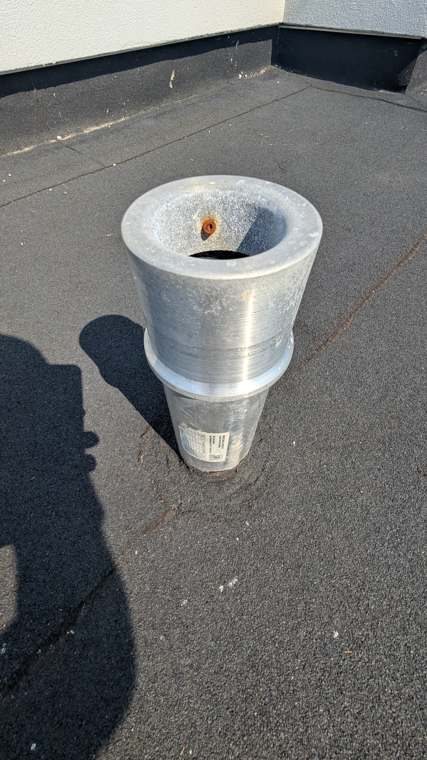
A roof vent with no damper and no seal on it. This one is just an open pipe into the building.
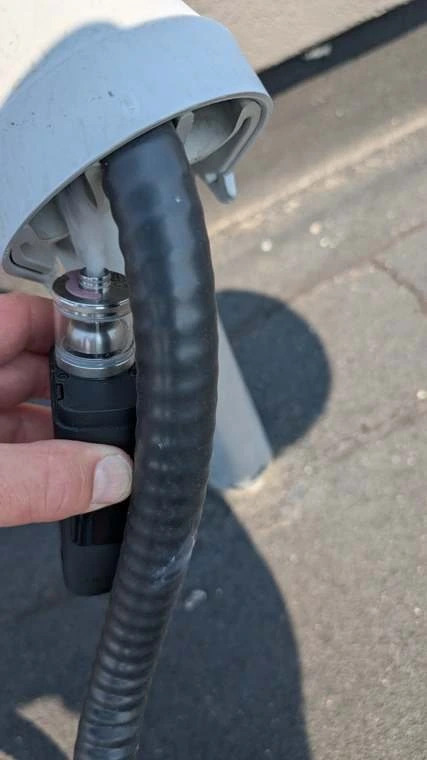
Smoke pencil at a conduit entry on a roof. Every conduit we checked on this house was pulling air in.
The exhaust dampers on the outside of the house are worth a look as well. Those little flaps at the dryer vent, range hood and bath fan outlets are supposed to fall shut when the fan stops, and they get gummed up with lint, painted open, or just worn out. One of them stuck open isn’t going to be the reason your bedroom smells like smoke, but most houses have four or five and they’re a cheap afternoon to sort out.
What a Blower Door Test Shows You
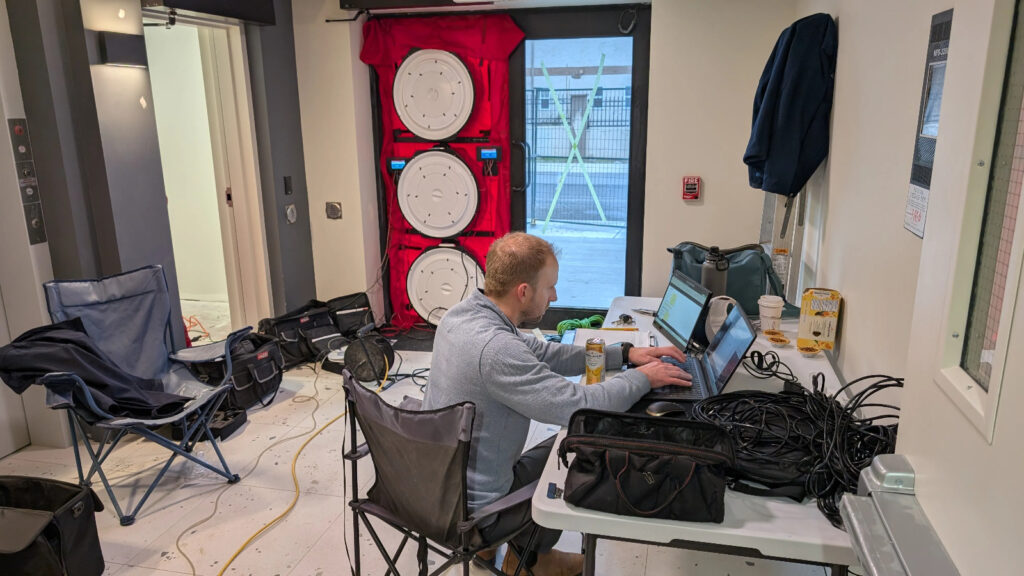
A blower door is a calibrated fan that goes in an exterior doorway. We use it to hold the house at a set negative pressure, usually 50 pascals, which is about what a steady 30 km/h wind would do if it hit the house from every direction at once.
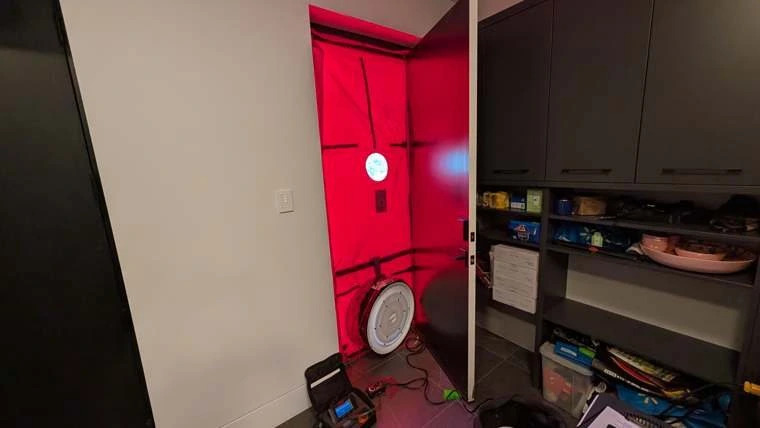
The blower door fan sealed into an exterior door. The red panel replaces the door for the length of the test.
You get a number for how leaky the house is, which is handy for comparing before and after. More to the point for smoke, it makes every leak in the building act up at the same time. Instead of chasing a draft you can only feel on a windy day, we can find them all in an afternoon.
With the fan running, we walk the house with an infrared camera and a smoke pencil. The camera picks up the temperature streaks where outside air is washing through the assembly. The smoke pencil confirms the exact spot and which way the air is moving. From there we put together a list of the areas that need to be addressed, in the order we would tackle them.
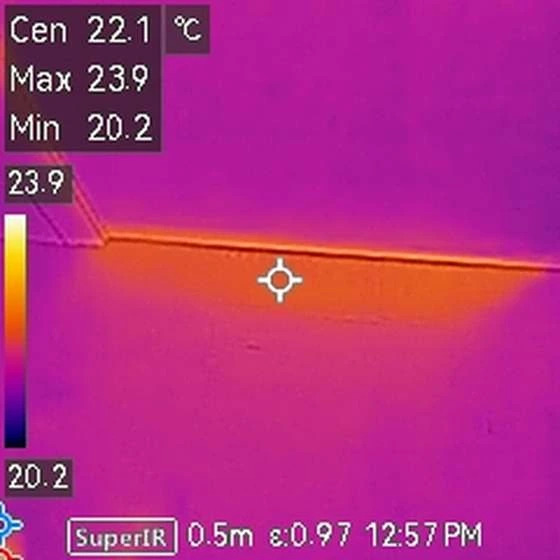
Thermal image of a front door with the house held negative. The bright band along the floor is outside air coming in under the door.
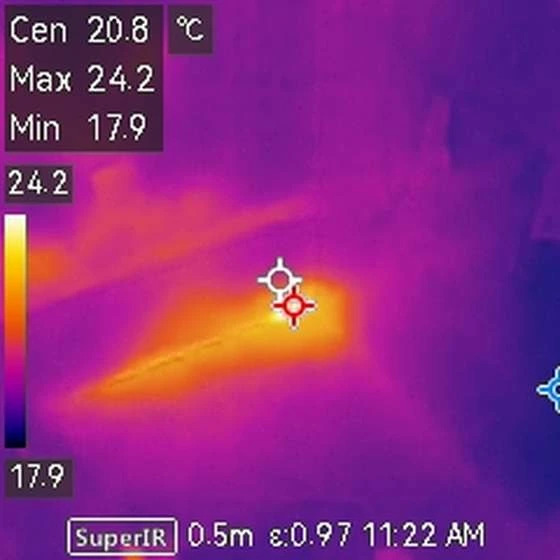
A floor and wall corner in a bathroom. The bright signature is air moving through the joint where the wall meets the floor.
Timing is important. Thermal imaging reads temperature difference across a surface, so it works best in winter, when it’s cold out and warm inside. In summer the only thing making that difference is the sun, and a wall only reads properly while the sun is on it and for a bit after. Summer testing is still great for finding air leaks, which is what you care about with smoke. It’s just not as good for mapping out missing insulation across the whole house. If insulation is the problem, fall or winter is the better time to diagnose this.
What Fixes It
Air sealing is half of it. Seal the attic penetrations and top plates, swap the old can lights for gasketed retrofit LED units, gasket the attic hatch, sort out the door weatherstripping, close up the garage penetrations, fix the exterior dampers. That alone will cut down what gets in.
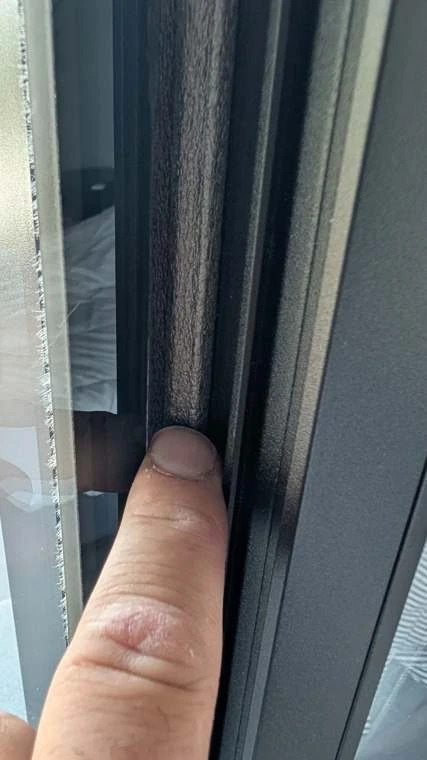
A sliding door with the gasket missing out of the stile completely. Not worn, gone. This was the single biggest leak inside that house, and it’s a parts-and-labour fix, not a renovation.
The other half is mechanical. A tighter house still needs air. You just want it showing up on your terms, through a filter, instead of through a hole in your attic. Usually that means one or more of these:
- An HRV with decent filtration. A heat recovery ventilator brings in a controlled, filtered supply of fresh air and pushes the stale stuff out, and it hangs onto most of the heat while it does. It also keeps the house closer to neutral pressure, which is exactly what you want when the air outside is bad.
- Running the furnace fan. Set it to run about 15 minutes an hour so the indoor air keeps cycling through the filter instead of just sitting there. Put a decent pleated filter in, but make sure it’s one your system can breathe through.
- Filter the deliberate openings, don’t block them. A filter on the open end of the make-up air pipe, or an inline duct filter on the fresh air intake, is a reasonable stopgap while you figure out the bigger picture.
- Go easy on the exhaust fans. On a really smoky day, a long run of the range hood is working against you. This one doesn’t cost anything and you don’t need anybody to come out and do it.
Do it in that order. Seal the house up first and then ventilate it on purpose. Ventilating a leaky house only filters a fraction of what comes in. Seal a house without sorting out the ventilation and you can end up with combustion safety and moisture problems that are a lot worse than smoke smell.
Frequently asked questions
My windows are closed and the AC is on. How is smoke still getting in?
Air conditioning doesn’t bring outdoor air in and it doesn’t seal anything up. All it does is cool the air that’s already in there. Meanwhile the stack effect, the wind and any fan you’ve got running are still moving outdoor air through the leaks in your ceiling, walls and floor. Closing the windows only covers one small piece of the envelope.
Can’t I just find the leaks myself with an incense stick?
You’ll find some of them. On a windy day you’ll pick up the obvious stuff around doors and outlets. What you won’t find are the leaks that only show themselves under pressure, and you’ll have no way to know which ones matter most or whether your fix worked. That’s what the blower door is for. It makes everything leak at once and gives you a number before and after.
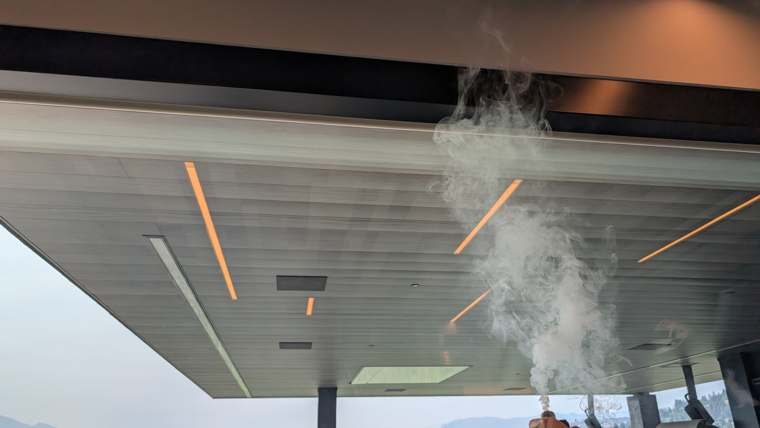
Smoke pencil held up at the head of a window from inside the house. The air is pushing in hard enough to blow the smoke back into the room.
Will an air purifier solve it?
A good HEPA unit in the bedroom helps, and if you’re in the middle of a bad air quality week, go do that today. But it’s treating the symptom. It’s cleaning up smoke that already made it inside, and it’ll keep doing that every summer as long as the hole is open. Sealing the hole is cheaper over the life of the house than running purifiers every smoke season.
Is this the same test builders do for the BC Energy Step Code?
It’s the same equipment, but we’re after a different thing. On a new build we’re using the blower door to get an airtightness number for code compliance and the energy model. On an existing house with a smoke problem, the score isn’t really the point. What you’re paying for is the walk-through: where the leaks are, how big they are, and what to fix first. You still get a number, and it’s useful as a baseline for the retest.
How long does it take, what does it cost, and what do I get?
Figure about two hours on site for a typical house. We set up the fan, take the airtightness reading, then walk the place under pressure with the camera and smoke pencil. We’ll tell you what we found before we leave, and you get a written report with photos and a prioritized list you can hand to your HVAC contractor or an insulation crew.
Typically it runs around $500 for the on-site time and the reporting on a home under 4,000 square feet. Larger homes take longer to walk and cost more.
How do I know the sealing work made a difference?
You test it again. It’s what one of our clients is doing right now. We tested the house, they’re working through the list, and we’ll go back and test again with the same fan at the same pressure. The difference between those two numbers is what you bought.
Do I need to do anything to get ready?
If you’ve got a wood stove or fireplace, don’t use it for 24 hours beforehand and clean the ash out, because depressurizing the house can pull it into the room. Close and latch all the exterior windows and doors, and leave the interior doors open. Everybody on site needs to pick inside or outside and stay put for the test, because opening a door partway through throws the reading off.
About The Author
